
Embedded Computing & MCU Architecture Guide: From MPU/MCU Boundaries to Real-Time Control
A deep dive into modern embedded architectures: MPU vs. MCU hardware boundaries, MMU virtualization vs. hard real-time interrupt determinism, Cortex-M and RISC-V pipelines, FreeRTOS scheduling, and engineering selection trees.
In smart hardware, robotics, and edge computing, compute platforms range from 8-bit microcontrollers with less than a kilobyte of SRAM to multi-gigahertz, multi-core single-board computers (SBCs) running full desktop Linux. Engineers often fall into binary extremes: attempting to run vision models on resource-starved microcontrollers causing out-of-memory faults, or using an SBC like a Raspberry Pi to directly generate high-frequency stepper pulses, only to suffer mechanical jitter caused by non-deterministic Linux scheduling.
The Embedded Boards and MCU Cheat Sheet catalogs a dense parameter matrix of boards and microcontrollers. This guide analyzes embedded computing from a computer architecture perspective: the hardware divide between MPUs and MCUs, interrupt determinism mechanics, modern core microarchitectures, and production engineering rules.
Embedded Architecture Comparison
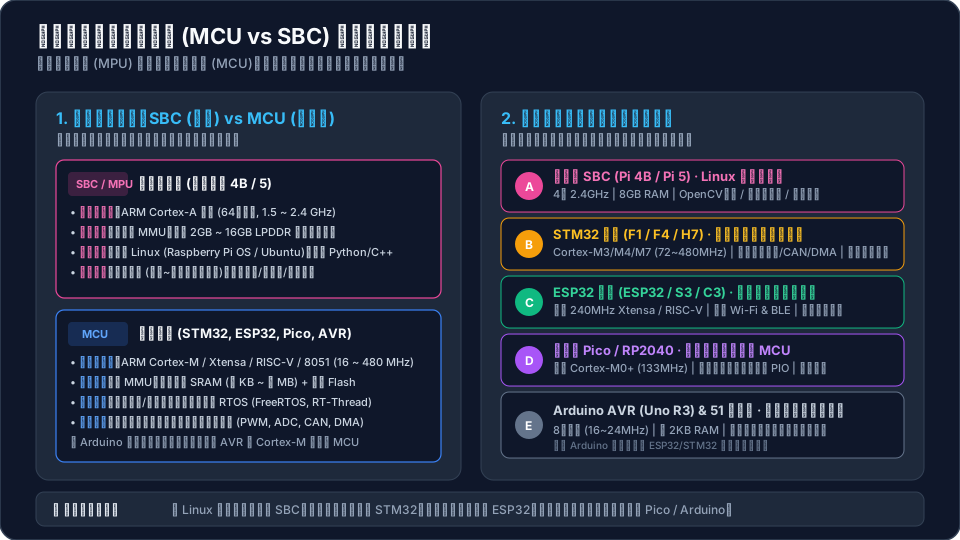
1. The Hardware Boundary: MPUs (SBCs) vs. MCUs (Microcontrollers)
Treating a Raspberry Pi as simply a "faster microcontroller" ignores a fundamental silicon architectural divide:
flowchart TD
    subgraph MPU_SYS["Single-Board Computer (MPU - e.g. Raspberry Pi 5)"]
        CPU_A["ARM Cortex-A76 Multi-Core (2.4 GHz)"] --> MMU["Hardware Memory Management Unit (MMU)"]
        MMU --> VIRT["Virtual Memory Address Space (48-bit)"]
        VIRT --> EXT_DDR["Off-Chip High-Speed LPDDR4/5 (Gigabytes)"]
        CPU_A --> L1L2L3["Multi-Tiered Cache (L1 / L2 / L3)"]
        CPU_A --> OS["Time-Sharing General-Purpose OS (Linux)"]
        OS --> APP["Multi-Process User Applications (Python / OpenCV)"]
    end

    subgraph MCU_SYS["Microcontroller System (MCU - e.g. STM32 / ESP32)"]
        CPU_M["ARM Cortex-M / RISC-V (MHz Scale)"] --> BUS["Multi-Layer Interconnect Bus Matrix"]
        BUS --> ON_SRAM["Tightly Coupled On-Chip SRAM (Kilobytes to Megabytes)"]
        BUS --> ON_FLASH["Zero-Wait-State On-Chip Flash"]
        BUS --> DMA_PERIPH["Hardware DMA Engine to Peripherals (ADC, PWM, CAN, SPI)"]
        CPU_M --> NVIC["Nested Vectored Interrupt Controller (NVIC - Nanoseconds)"]
        CPU_M --> RTOS["Bare-Metal Superloop / Hard Real-Time OS (FreeRTOS)"]
    end
1. Hardware MMUs and Virtualization Latency
- Microprocessor Units (MPU / SBC):
- Must incorporate a hardware Memory Management Unit (MMU). The MMU maps process logical addresses to physical RAM via page tables, isolating process memory spaces. If a user application crashes, the kernel remains protected.
- The Latency Cost: When the processor experiences a Translation Lookaside Buffer (TLB) miss or a page fault, instruction pipelines stall while traversing memory page hierarchies, injecting non-deterministic latency jitter ranging from microseconds to several milliseconds.
- Microcontrollers (MCU - STM32, ESP32, RP2040):
- Omit the MMU completely. Code and data execute within a single flat physical address space.
- The Determinism Benefit: Pointers directly address physical silicon registers and static on-chip SRAM. Instruction execution and memory fetch cycles are 100% cycle-deterministic, providing the foundation for hard real-time guarantees.
2. Cache Invalidation vs. Tightly Coupled Memory
- A 2.4 GHz Cortex-A processor experiences a massive latency penalty (tens of nanoseconds) accessing external LPDDR RAM. To maintain pipeline throughput, it relies on multi-tier L1/L2/L3 caches. A cache miss during a mission-critical motor control loop introduces unavoidable timing variations.
- Modern MCUs integrate CPU cores with SRAM and Flash on a single silicon die. High-performance MCUs (like the STM32H7) feature Tightly Coupled Memory (ITCM / DTCM), allowing single-cycle zero-wait instruction and data access that eliminates cache miss penalties entirely.
2. Core Microarchitectures
flowchart LR
    ROOT["MCU Core Microarchitectures"] --> ARM["ARM Cortex-M Family<br/>(Industry Standard)"]
    ROOT --> XTENSA["Cadence Xtensa<br/>(ESP32 / ESP32-S3)"]
    ROOT --> RISCV["Open-Source RISC-V<br/>(ESP32-C Series / CH32V)"]

    ARM --> M0["Cortex-M0+: Ultra-Low Power / 2-Stage Pipeline"]
    ARM --> M4["Cortex-M4F: Hardware FPU / Single-Cycle MAC DSP"]
    ARM --> M7["Cortex-M7: Dual-Issue Superscalar / 6-Stage Pipeline"]
1. The ARM Cortex-M Matrix & Hardware NVIC
The ARM Cortex-M architecture dominates industrial automation, automotive electronics, and precision robotics:
- Nested Vectored Interrupt Controller (NVIC):
- Tightly coupled directly into the core pipeline, supporting up to 240 physical interrupt vectors with multi-level programmable preemption priority.
- Hardware Stacking and Unstacking: Upon detecting an interrupt, hardware automatically pushes core registers (
R0-R3, R12, LR, PC, xPSR) onto the active stack, achieving an interrupt response latency of only 12 clock cycles (under 75 nanoseconds at 168 MHz). - Tail-Chaining: If an interrupt finishes while another pending interrupt arrives, the core bypasses the unstacking and stacking cycles, switching handlers in just 6 cycles to maintain deterministic signal sampling.
- Architectural Tiers:
- Cortex-M0+ (e.g., Raspberry Pi Pico RP2040): Minimalist 2-stage pipeline delivering ultra-low dynamic energy consumption for sensor aggregation.
- Cortex-M4F (e.g., STM32F407): Integrates an IEEE-754 single-precision floating-point unit (FPU) and single-cycle multiply-accumulate (MAC) DSP instructions, computing Field-Oriented Control (FOC) Clarke and Park vector transforms in microseconds.
- Cortex-M7 (e.g., STM32H743): A dual-issue superscalar 6-stage pipeline running at 480-550 MHz with dynamic branch prediction, bridging the gap between microcontrollers and application processors.
2. Cadence Xtensa LX Series (Espressif ESP32)
- Powering the classic ESP32 and ESP32-S3 via 32-bit Xtensa LX6/LX7 dual cores running at 240 MHz.
- Asymmetric Multiprocessing (AMP): Standard industry architecture binds Core 0 to Espressif's real-time Wi-Fi/Bluetooth RF stack, leaving Core 1 exclusively dedicated to user application logic. This prevents network packet bursts from preempting critical control loops.
3. Open-Source RISC-V
- Architectures like the ESP32-C3/C6 and WCH CH32V use modular RISC-V instruction sets (RV32IMAC), eliminating proprietary license royalties while delivering efficient code density. WCH integrates custom hardware fast-interrupt extensions (HPE) that rival ARM NVIC dispatch performance.
3. Real-Time Scheduling Mechanics
Speed is not real-time capability. Real-time engineering centers strictly on bounded latency and timing predictability.
Hard vs. Soft Real-Time
| Characteristic | Soft Real-Time (e.g. Raspberry Pi Linux) | Hard Real-Time (e.g. STM32 with FreeRTOS) |
|---|---|---|
| Deadline Miss Penalty | Degraded user experience (audio stutter, dropped frames) | Total physical failure (inverted pendulum crash, ABS brake lockup) |
| Response Horizon | Variable, typically 5 ms to 50 ms | Deterministic sub-millisecond, down to nanoseconds |
| Scheduling Core | Completely Fair Scheduler (CFS) time-sharing | Strict priority-preemptive scheduler |
| Interrupt Jitter | High (kernel context switching, deferred bottom-half work) | Minimal, cycle-bounded by hardware NVIC logic |
3 Embedded Software Scheduling Paradigms
flowchart TD
    subgraph S1["1. Bare-Metal Superloop + ISR"]
        LOOP["Background: while(1) polling loop"]
        ISR["Foreground: Hardware peripheral asynchronous ISRs"]
        ISR -.-> |Preempts| LOOP
    end

    subgraph S2["2. Preemptive RTOS (FreeRTOS)"]
        T1["High-Priority Control (1 kHz PID Loop)"]
        T2["Medium-Priority Communication (CAN / UART)"]
        T3["Low-Priority Background (Telemetry / UI)"]
        SCHED["Systick Preemptive Scheduler"]
        SCHED --> |Suspends T2 to Wake T1| T1
    end

    subgraph S3["3. Time-Sharing Multi-Process OS (Linux)"]
        KERNEL["Linux Kernel CFS Scheduler"]
        P1["Vision Pipeline (User Space)"]
        P2["Cloud Web Server (User Space)"]
        P3["Hardware Device Drivers (Kernel Space)"]
    end
- Bare-Metal Superloop: Zero OS footprint, but vulnerable to blocking delays (
delay_ms(100)) that paralyze unrelated sensor monitoring. - Preemptive RTOS (FreeRTOS / Zephyr): Allocates independent task priority queues. When an external hardware event releases a semaphore or timer, the scheduler context-switches in microseconds, occupying as little as 6 KB of SRAM.
4. Hardware Selection Decision Tree
flowchart TD
    START["Hardware Selection"] --> Q1{"Requires Desktop Linux, Computer Vision, or Complex ML?"}

    Q1 --> |Yes| SBC["Choose Single-Board Computer (SBC)<br/>• Raspberry Pi 5 (Maximum CPU & Ecosystem)<br/>• Orange Pi 5 (High-Performance NPU)<br/>• Raspberry Pi Zero 2 W (Compact Form Factor)"]
    Q1 --> |No (Focused on Real-Time Control & Hardware I/O)| Q2{"Native Wi-Fi / Bluetooth Required?"}

    Q2 --> |Yes (Wireless Connectivity)| ESP["Choose Espressif ESP32 Series<br/>• General IoT: ESP32 Classic<br/>• Edge AI / Screen UI: ESP32-S3<br/>• Cost-Sensitive / 8-Bit Replacement: ESP32-C3<br/>• Matter / Thread Smart Home: ESP32-C6"]

    Q2 --> |No (Industrial Automation / Deterministic Control)| Q3{"Demands Industrial Busses (CAN) or High-Speed Analog?"}

    Q3 --> |High (Motor Control / Automotive / Noise Immunity)| STM["Choose STM32 Family<br/>• General Purpose: STM32F103<br/>• Motion & Flight Controllers: STM32F407<br/>• Digital Power & Inverters: STM32G474<br/>• Ultra-High Compute: STM32H743"]

    Q3 --> |Medium (Flexible Peripheral Emulation & Fast Prototyping)| PICO["Choose Raspberry Pi Pico (RP2040 / RP2350)<br/>• Dual Core + Programmable I/O State Machines (PIO)<br/>• Low Cost + MicroPython / C++ SDK"]

    Q3 --> |Rapid Education / Prototyping| ARDUINO["Choose Arduino / Maker Ecosystem<br/>• Sensor Prototyping: Arduino Uno R4 / Nano<br/>• Core Architecture Study: 8051 / CH32V003"]
3 Production Rules for Embedded Engineering
Rule 1: Heterogeneous Decoupling (SBC Master + MCU Worker)
In autonomous robotics or computer vision systems, never attempt to run everything on a single compute unit:
- High-Level Brain (SBC - Raspberry Pi): Runs Linux, mounts USB/CSI cameras, computes OpenCV perception pipelines, runs SLAM LiDAR navigation, and communicates with cloud servers via WebSockets or MQTT.
- Low-Level Motor Reflex (MCU - STM32 / RP2040): Runs a 1 kHz PID loop calculating encoder ticks, generating PWM motor waveforms, and monitoring emergency hardware limit switches.
- Interconnect: Connect the two via high-speed UART (115200 to 921600 bps) or CAN bus with structured packet validation. This prevents Linux kernel scheduling delays from compromising physical motor control.
Rule 2: Breaking the Power Wall via Deep Sleep & DMA
For battery-powered remote sensor nodes:
- Deep Sleep States: Active Wi-Fi transmission consumes 100-250 mA. Entering Deep Sleep disables main cores and high-speed clocks, preserving only the Ultra-Low-Power (ULP) coprocessor or real-time clock (RTC), dropping draw to 10-20 microamps. Waking up for 1 second every 10 minutes extends battery life from days to years.
- Hardware Direct Memory Access (DMA): When transferring multi-megabyte ADC sample streams or pushing buffers over SPI to display controllers, configure peripheral DMA channels to transfer data between memory and busses autonomously without CPU cycle intervention.
Rule 3: Modernizing Toolchains with PlatformIO
Move away from legacy IDE environments (like Keil MDK) toward modern developer workflows using VS Code + PlatformIO. A single platformio.ini specification declaratively manages cross-compilers (ARM-GCC, RISC-V-GCC), dependency libraries, and debug probe drivers, integrating cleanly with Git versioning and automated CI/CD pipelines.