
Στα ενσωματωμένα συστήματα, το IoT και την ανάπτυξη έξυπνου υλικού, η επιλογή της βέλτιστης υπολογιστικής πλατφόρμας είναι η θεμελιώδης απόφαση σχεδιασμού. Οι μηχανικοί συχνά συγχέουν τους Υπολογιστές Μονής Πλακέτας (SBCs), τους Μικροελεγκτές (MCUs) και τα περιβάλλοντα ανάπτυξης (όπως το Arduino), οδηγώντας σε αναντιστοιχίες απόδοσης, πραγματικού χρόνου και κατανάλωσης ενέργειας.
Αυτό το cheat sheet παρέχει μια δομημένη σύγκριση των Raspberry Pi (SBC και Pico), Arduino, STM32, ESP32, 8051 και σύγχρονων παραγώγων RISC-V.
🔗 Σχετικά Cheat Sheets: Τσιπ Τεχνητής Νοημοσύνης & Επιταχυντές · Εντολές Linux · Python Cheat Sheet
Architectural Landscape: MCU vs. SBC Overview
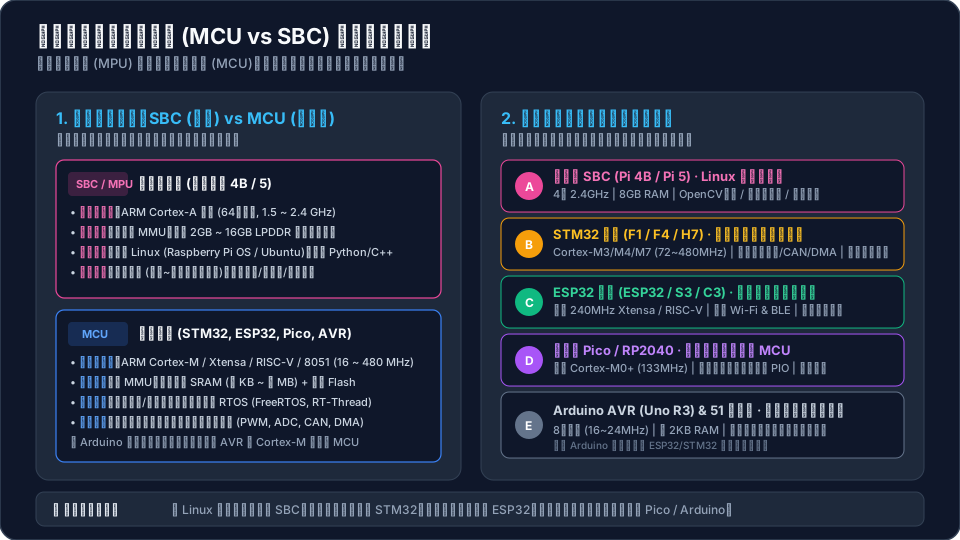
1. Core Architectural Paradigm: Single-Board Computer (SBC) vs. Microcontroller (MCU)
Before selecting hardware, engineers must recognize the fundamental architectural divide separating Single-Board Computers (SBC / MPU) from Microcontrollers (MCU):
| Comparison Dimension | Single-Board Computer (SBC / MPU) | Microcontroller Unit (MCU / Microcontroller) |
|---|---|---|
| Representative Platforms | Raspberry Pi 4B / 5, Orange Pi, BeagleBone | STM32, ESP32, Raspberry Pi Pico (RP2040), Arduino Uno (ATmega328P), 8051 |
| Core Microarchitecture | ARM Cortex-A Series (e.g., Cortex-A72, A76, 64-bit superscalar multicore) | ARM Cortex-M Series, Xtensa LX6/LX7, RISC-V, 8-bit AVR / 8051 |
| Memory Management Unit (MMU) | Hardware MMU present: Supports virtual memory mapping, page tables, and memory protection | Typically No MMU (some high-end MCUs feature an MPU for region protection without virtual addressing) |
| Operating Runtime | Full-fledged General-Purpose OS (Linux, Debian, Ubuntu, Android) | Bare-metal firmware or Hard Real-Time Operating Systems (RTOS) (FreeRTOS, Zephyr, RT-Thread) |
| Clock Speed & Compute | 1.2 GHz – 2.4 GHz+; Hardware FPU, NEON/SIMD vector extensions | 16 MHz – 480 MHz (select parts reach 600 MHz); single-cycle instruction execution |
| Memory Hierarchy | Discrete on-board LPDDR4 / LPDDR5 SDRAM (1 GB – 16 GB) + MicroSD / PCIe NVMe | On-chip tightly coupled Static RAM (few KB to few MB) + on-chip/external NOR Flash |
| Real-Time Determinism | Soft real-time / Non-deterministic: Subject to kernel task scheduling and IRQ latency (millisecond jitter) | Hard Real-Time: Deterministic nanosecond-to-microsecond hardware interrupt response |
| Power & Thermal Budget | 2.5 W – 15 W+; Requires passive heatsinks or active cooling fans under load | Tens of milliwatts (mW) down to microamps (µA); supports ultra-low-power sleep modes |
| Primary Domain | High-level tasks: OpenCV computer vision, multimedia encoding, edge AI inference, Web services | Low-level control: Motor FOC vector control, precise sensor sampling, industrial buses, battery devices |
2. Core Specifications of Six Mainstream Platforms
| Platform / Silicon Family | Architecture & Core Type | Typical Clock Speed | On-Chip / System RAM | Typical Storage (Flash/ROM) | Integrated Wireless | Determinism & Primary OS | Toolchain & Languages | Typical Board Price | Primary Niche & Value Proposition |
|---|---|---|---|---|---|---|---|---|---|
| Raspberry Pi SBC (Raspberry Pi 4B/5) |
SBC (MPU) Quad-core ARM Cortex-A76 / A72 (64-bit) |
1.8 GHz – 2.4 GHz | 2 GB – 8 GB LPDDR4X | External MicroSD / PCIe NVMe SSD | Dual-band Wi-Fi 5/6 + BLE 5.0 + Gigabit Ethernet | Soft Real-Time Raspberry Pi OS (Linux) |
GCC/Clang, Python, C/C++, Docker | $35 – $100+ | Compute Ceiling: Runs full desktop Linux, scientific computing packages, and edge vision models |
| STM32 (STMicroelectronics) |
MCU ARM Cortex-M0+/M3/M4/M7/H7 |
48 MHz – 480 MHz (H7 to 550 MHz) | 20 KB – 1 MB+ on-chip SRAM | 64 KB – 2 MB on-chip Flash | None native (select STM32WB/WBA feature BLE) | Hard Real-Time Bare-metal / FreeRTOS / Zephyr |
Keil MDK, STM32CubeIDE, IAR, C/C++ | $2 – $25 | Industrial Control Benchmark: Rich advanced timers, dual CAN buses, fast ADCs, hardware DMA |
| ESP32 Family (Espressif Systems) |
MCU Dual-core Xtensa LX6/LX7 or 32-bit RISC-V |
160 MHz – 240 MHz | 320 KB – 512 KB SRAM + external PSRAM | 4 MB – 16 MB external SPI Flash | Native integrated 2.4G Wi-Fi + BLE 4.2/5.0 | Hard Real-Time FreeRTOS (native dual-core SMP) |
ESP-IDF (C/C++), Arduino IDE, MicroPython | $2.5 – $10 | King of IoT Value: Ultra-low-cost native Wi-Fi & BLE RF with battle-tested networking stacks |
| Raspberry Pi Pico (RP2040 / RP2350) |
MCU Dual Cortex-M0+ or dual Cortex-M33 + RISC-V |
133 MHz – 150 MHz | 264 KB – 520 KB SRAM | 2 MB – 16 MB external QSPI Flash | Pico W features native Wi-Fi 4 + BLE | Hard Real-Time Bare-metal / FreeRTOS |
C/C++ SDK, MicroPython, Arduino IDE | $4 – $7 | Programmable I/O (PIO): Dedicated state machines emulate arbitrary high-speed digital buses |
| Arduino AVR (e.g., Uno R3) |
MCU Ecosystem 8-bit AVR (ATmega328P) |
16 MHz | 2 KB SRAM | 32 KB Flash (incl. 0.5 KB bootloader) | None native (requires shield) | Bare-metal polling (super-loop architecture) |
Arduino IDE, PlatformIO, C/C++ | $3 (clone) – $25 (original) | Rapid Prototyping Benchmark: Massive global library ecosystem and unified hardware abstraction API |
| 8051 Family (STC89 / STC8 / 8051) |
MCU Classic 8-bit CISC 8051 (12T / 1T) |
11.0592 MHz – 35 MHz | 512 B – 8 KB SRAM | 4 KB – 64 KB Flash | None native | Bare-metal polling (Hardware ISRs) |
Keil C51, SDCC, C / Assembly | $1.5 – $5 | Pedagogical Hardware Foundation: Clear direct register mapping for teaching computer architecture fundamentals |
3. Detailed Hardware Family Breakdown
01. Raspberry Pi: Dual-Track SBC and MCU Ecosystem
- Single-Board Computers (SBCs - Running Full Linux):
- Raspberry Pi 5: Broadcom BCM2712 (Quad Cortex-A76 @ 2.4 GHz), custom RP1 southbridge, native PCIe 2.0 interface; ideal for robot decision brains and industrial compute nodes.
- Raspberry Pi 4B: Broadcom BCM2711 (Quad Cortex-A72 @ 1.5 GHz), Gigabit Ethernet, dual 4K micro-HDMI; industry standard for high-concurrency Linux edge gateways.
- Raspberry Pi Zero 2 W: Ultra-compact quad-core (A53 @ 1.0 GHz), gumstick form factor; optimal for drone payloads and portable embedded hubs.
- Microcontrollers (MCUs - Bare-metal and RTOS):
- Raspberry Pi Pico / Pico W: Powered by RP2040 (Dual Cortex-M0+ @ 133 MHz, 264 KB SRAM), equipped with 8 independent PIO hardware state machines capable of driving DVI video, WS2812 LED strings, and custom protocols with zero CPU intervention.
- Raspberry Pi Pico 2 / Pico 2 W: Upgraded to RP2350 (Dual Cortex-M33 + dual Hazard3 RISC-V switchable cores @ 150 MHz), featuring Arm TrustZone hardware security.
02. Arduino Ecosystem: From Classical AVR to Modern 32-Bit
- Core Concept: Arduino encompasses both open-source hardware designs and the Arduino Core software abstraction framework. Modern Arduino libraries cross platform boundaries, supporting ESP32, STM32, and RP2040.
- Hardware Milestones:
- Arduino Uno R3 (Classic): Microchip ATmega328P (8-bit AVR, 16 MHz, 2 KB SRAM). Severely resource-constrained; unsuitable for network stacks or floating-point math, ideal for basic sensor logic.
- Arduino Uno R4 (Modern): Powered by Renesas RA4M1 (32-bit ARM Cortex-M4 @ 48 MHz, 32 KB SRAM, 256 KB Flash), hardware FPU, 12-bit DAC, and CAN bus; the WiFi edition pairs with an ESP32-S3 coprocessor for wireless networking.
- Arduino Mega 2560: 54 digital I/O pins and 16 analog inputs; historical controller of early 3D printer firmwares (Marlin).
03. STM32 Family: Industrial-Grade Cortex-M Matrix
STMicroelectronics dominates industrial and motion control through consistent peripherals and clear naming conventions:
| Series | Core Microarchitecture & Frequency | Typical Positioning | Key Models & Peripherals |
|---|---|---|---|
| STM32F1 Series | Cortex-M3 @ 72 MHz | Mainstream entry; educational standard | STM32F103C8T6 ("Blue Pill", 20 KB RAM, 64 KB Flash, 2x ADC, CAN) |
| STM32F4 Series | Cortex-M4F @ 168 – 180 MHz (Hardware FPU) | High-performance mainstream; quadcopters and robotics | STM32F407VGT6 (192 KB RAM, 1 MB Flash, Ethernet MAC, camera DCMI interface) |
| STM32G0 / G4 Series | Cortex-M0+ / M4 (Motor & power optimized) | High-integration modern replacement with fast analog | STM32G474 (High-resolution timer HRTIM, op-amps, for digital SMPS & motor FOC) |
| STM32H7 Series | Cortex-M7 (Single/Dual core) @ 480 – 550 MHz | Compute ceiling MCU, closing the gap with MPUs | STM32H743 / H750 (1 MB RAM, double-precision FPU, external SDRAM & audio I2S) |
04. ESP32 Family: Espressif Wireless IoT Product Matrix
ESP32 transformed connected hardware economics:
| Silicon Series | CPU Core & Clock Speed | Wireless Connectivity | Key Architectural Feature | Ideal Project Scenarios |
|---|---|---|---|---|
| ESP32 (Original Classic) | Dual-core 32-bit Xtensa LX6 @ 240 MHz | Wi-Fi 4 (802.11 b/g/n) + BLE 4.2 | 520 KB SRAM, mature ecosystem libraries | Smart plugs, connected clocks, sensor telemetry hubs |
| ESP32-S3 | Dual-core 32-bit Xtensa LX7 @ 240 MHz | Wi-Fi 4 + BLE 5.0 (Long Range) | Vector instruction extensions accelerating edge neural network models | Smart displays (LVGL), offline voice recognition, ESP-WHO vision |
| ESP32-C3 | Single-core 32-bit RISC-V @ 160 MHz | Wi-Fi 4 + BLE 5.0 | Pin-compatible with ESP8266, ultra-low silicon cost | Upgrading legacy 8-bit MCUs and ESP8266 fleets |
| ESP32-C6 | Single-core 32-bit RISC-V @ 160 MHz | Wi-Fi 6 (2.4 GHz) + BLE 5.3 + Zigbee 3.0 / Thread (Matter) | Native multi-protocol smart home standard support | Native Matter endpoints, low-power mesh routers |
05. 8051 and Modern Low-Cost RISC-V Microcontrollers
- Classic 8051 (e.g., AT89C52 / STC89C52): Traditional 12-clock (12T) architecture with accumulator registers A/B and program status word (PSW). Programmed via UART without on-chip hardware debugging; classic academic teaching tool.
- Enhanced 1T 8051 (STC8 / STC15 Series): 1-clock (1T) single-cycle core executing instructions 8–12x faster, featuring internal high-precision RC oscillators, hardware ADCs, and PWM channels.
- Ultra-Low-Cost RISC-V (WCH CH32V Series):
- CH32V003: QingKe 32-bit RISC-V core (48 MHz, 2 KB SRAM, 16 KB Flash), priced at cents in volume; widely replacing 8-bit 8051 microcontrollers in consumer electronics.
- CH32V307: Integrates Gigabit Ethernet PHY and dual USB high-speed controllers, pin-compatible with STM32 footprints.
4. Hardware Peripheral Buses & Interface Selection
| Bus Interface | Conductor Count | Mode & Topology | Typical Data Rate | Max Distance | Core Advantages | Engineering Gotchas & Pitfalls |
|---|---|---|---|---|---|---|
| GPIO | 1 pin | Push-Pull / Open-Drain | DC to tens of MHz | Board-level (< 30 cm) | Fundamental high/low logic I/O and interrupt triggers | Output drive limits (typically 4 mA – 20 mA); requires MOSFET/transistor drivers for inductive loads |
| UART | 2 lines (TX, RX) + GND | Full-duplex / Point-to-point asynchronous | 9600 bps – 921600 bps (standard 115200) | Few meters (hundreds of meters via RS-232/485) | De-facto debug console logging, GPS, and Bluetooth modems | No clock line; baud rates must match within 2–3%; shared ground is mandatory |
| I2C | 2 lines (SCL, SDA) | Half-duplex / Multi-master, multi-slave synchronous | 100 kHz (Standard), 400 kHz (Fast), 1 MHz | Short distance (< 50 cm) | Connects dozens of devices over 2 wires (OLED, IMU, sensors) | Requires pull-up resistors (typically 4.7 kΩ); duplicate hardcoded slave addresses block shared bus |
| SPI | 4 lines (SCK, MOSI, MISO, CS) | Full-duplex / Master-slave synchronous | 10 MHz – 80 MHz+ | Very short (< 20 cm) | High throughput; ideal for color TFT displays, Flash, and SD cards | High pin count (requires dedicated CS per slave); lacks hardware flow control and error checking |
| CAN Bus | 2 lines (CAN_H, CAN_L differential) | Half-duplex / Multi-master broadcast differential | 125 kbps – 1 Mbps (CAN FD up to 8 Mbps) | 40 m to several km | Industrial-grade reliability: Hardware CRC validation, automatic retry, high noise immunity | Requires external CAN transceivers (e.g., TJA1050); bus ends must be terminated with 120 Ω resistors |
| ADC | 1 analog pin | Single-ended or differential analog sampling | Tens of kSPS to MSPS; 10/12/16-bit resolution | Direct board trace | Interfacing thermistors, photoresistors, and battery dividers | ESP32 ADC exhibits non-linear response near 0V and 3.3V rails; STM32 ADC linearity is vastly superior |
| PWM | 1 digital timer pin | Periodic square wave with modulating duty cycle | Tens of Hz to hundreds of kHz | Board-level | Motor speed control, hobby servos (50 Hz), LED dimming | Servos require jitter-free period timing; software delays cause twitching, necessitating hardware timer channels |
5. Engineering Project Decision Matrix
| Project Requirements | Primary Recommended Platform | Cost-Effective Alternative | Design Advice & Architecture Notes |
|---|---|---|---|
| Desktop Linux / Computer Vision / Edge AI (e.g., autonomous rover camera tracking, LiDAR SLAM, mini servers) |
Raspberry Pi 4B / 5 (SBC) | Orange Pi 5 / Raspberry Pi CM4 Module | Do not attempt on classical MCUs; microcontrollers cannot load full OpenCV or deep learning models. Guard against SD card filesystem corruption by mounting read-only roots or NVMe SSDs. |
| Hard Real-Time Motor & Motion Control (e.g., quadcopter flight controllers, 3D printers, robotic arms, BLDC FOC) |
STM32F4 / STM32G4 / STM32H7 | Raspberry Pi Pico (RP2040) / TI C2000 | Avoid driving motors directly from Linux SBC GPIOs (OS scheduling jitter causes dropped steps). Standard industrial architecture: Raspberry Pi handles vision/navigation, streaming trajectories over UART/CAN to an STM32 motor controller. |
| Connected IoT / Smart Home Endpoints (e.g., Matter home sensors, Wi-Fi weather stations, telemetry loggers) |
ESP32 Family (ESP32-S3 / C3) | Raspberry Pi Pico W / ESP8266 | Avoid adding external Wi-Fi AT modems to legacy MCUs (leads to serial framing deadlocks); ESP32's dual-core SMP allows running the Wi-Fi stack on Core 0 while user logic executes on Core 1. |
| Beginner Learning / Rapid Physical Prototyping (e.g., academic coursework, creative installations, fast POCs) |
Arduino Ecosystem (Uno R4 / ESP32 + Arduino IDE) | Raspberry Pi Pico (MicroPython) | If the goal is verifying a concept within days, avoid configuring complex bare-metal clock trees; leverage community-tested Arduino driver libraries for quick execution. |
| High-Volume Cost-Constrained Consumer Products (e.g., electric toothbrushes, battery chargers, simple remotes) |
WCH CH32V003 / Puya / Fudan Micro | STC8 Series 1T 8051 | High-volume production is sensitive to pennies of silicon cost. Modern sub-dollar 32-bit RISC-V microcontrollers match legacy 8051 pricing while delivering superior peripherals and 32-bit math. |
6. Embedded Toolchains & Hardware Debugging
| Toolchain / Debugger | Supported Hardware | Physical Pins & Protocols | Core Benefits | Recommended Use Cases |
|---|---|---|---|---|
| ST-Link / J-Link / DAP-Link | STM32, RP2040, ARM Cortex-M | SWD (SWDIO, SWCLK; 2 pins) or JTAG (5 pins) | Hardware breakpoints, single-step execution, live memory/register inspection | Standard engineering daily driver; hardware debugging is significantly faster than UART printf |
| USB DFU / UF2 Drag-and-Drop | Raspberry Pi Pico (RP2040), ESP32-S3, modern STM32 | Standard USB Type-C cable | No debugger required: Holding BOOT button mounts a mass storage drive; dragging firmware flashes the chip | Ideal for workshops, rapid demos, and field updates without dedicated debug probes |
| UART ISP (In-System Programming) | 8051 (STC), ESP32, STM32 system memory boot | UART (TX, RX) via CH340 / CP2102 | Minimal cost; requires only serial pins | Factory flashing jigs and recovery flashing on legacy 8051 or ESP32 boards |
| PlatformIO (VS Code Extension) | Cross-Platform (ESP32, STM32, Arduino, RP2040) | Bridges with standard SWD/JTAG debuggers | Modern IDE workflows: Replaces legacy IDE interfaces; automatically manages toolchains, board configs, and library dependencies | Professional cross-platform embedded software development |